
Hóng Shāo Ròu (Red-Braised Pork Belly)
When I think of Hóng Shāo Ròu (红烧肉), or in English, Stewed Pork Belly, it brings back so many memories. I grew up with my grandparents in China, and this dish was a frequent staple in our household. Oddly, in recent years, I’ve almost never cooked it because it’s so rich, and because I carry many painful memories associated with it.
Back in the day, I was a chubby girl who loved eating. Inevitably, I was heavier than the average kid. In adults’ minds, I was labeled “fat.” Back in China, people had no filter when it came to body shaming. My family would call me “fat” and rub it in my face. I probably didn’t mind until I got a bit older.
One memory stands out vividly. My uncle came to my grandparents’ home for a visit, and my grandparents made my favorite Hóng Shāo Ròu. Like a dedicated foodie, I devoured a big bowl of rice topped with chunks of juicy meat and its thick, almost gooey sauce that coated every grain. When I was debating a second round, my uncle announced that my grandparents were spoiling me. They were feeding me a whole pig. I think that was the first time in my short, short life that I felt body shamed. I didn’t get that second bowl.
Ever since then, my uncle loved to repeat the same analogy of me devouring a whole pig, over and over. Everyone else laughed it off. My grandparents took it as a badge of honor that they had “raised a pig.” No one defended me.
I don’t remember what happened after that. I still love Hong Shao Rou, but I don’t enjoy it as much as I used to. When this dish is on the table, I always consciously control my portions. As an adult, I avoided it even more. It’s rare for me to cook it now unless I have people to share it with. Whenever it’s in front of me, I’m reminded of the ridicule.
You may wonder whether I hated these family members (including my own parents) for being so insensitive. Spoiler: I did. I held my grudge against them for a very long time. This was only one instance. I was body shamed constantly, not just by them, but at school and by strangers. It took me a while to finally forgive them.
I learned that my parents’ and grandparents’ generation lived through war, famine, and the Cultural Revolution. Food scarcity shaped their lives. When they came out of it, the abundance of food led to indulgence, for themselves and for the next generations. It was a sign of prosperity. Knowing their upbringing makes it easier to forgive. Although the effects of body shaming still stay with me, it’s up to me to navigate them in a positive way.
Today, I am still a "chubby" woman who loves food. The only difference is that I am bulletproof from body shamers. I chose to make and celebrate Hóng Shāo Ròu, and I am sharing it with my husband and friends. It's rich, indulgent food, and there is nothing wrong with savoring it in moderation. The shame was never part of the recipe.

The Braise
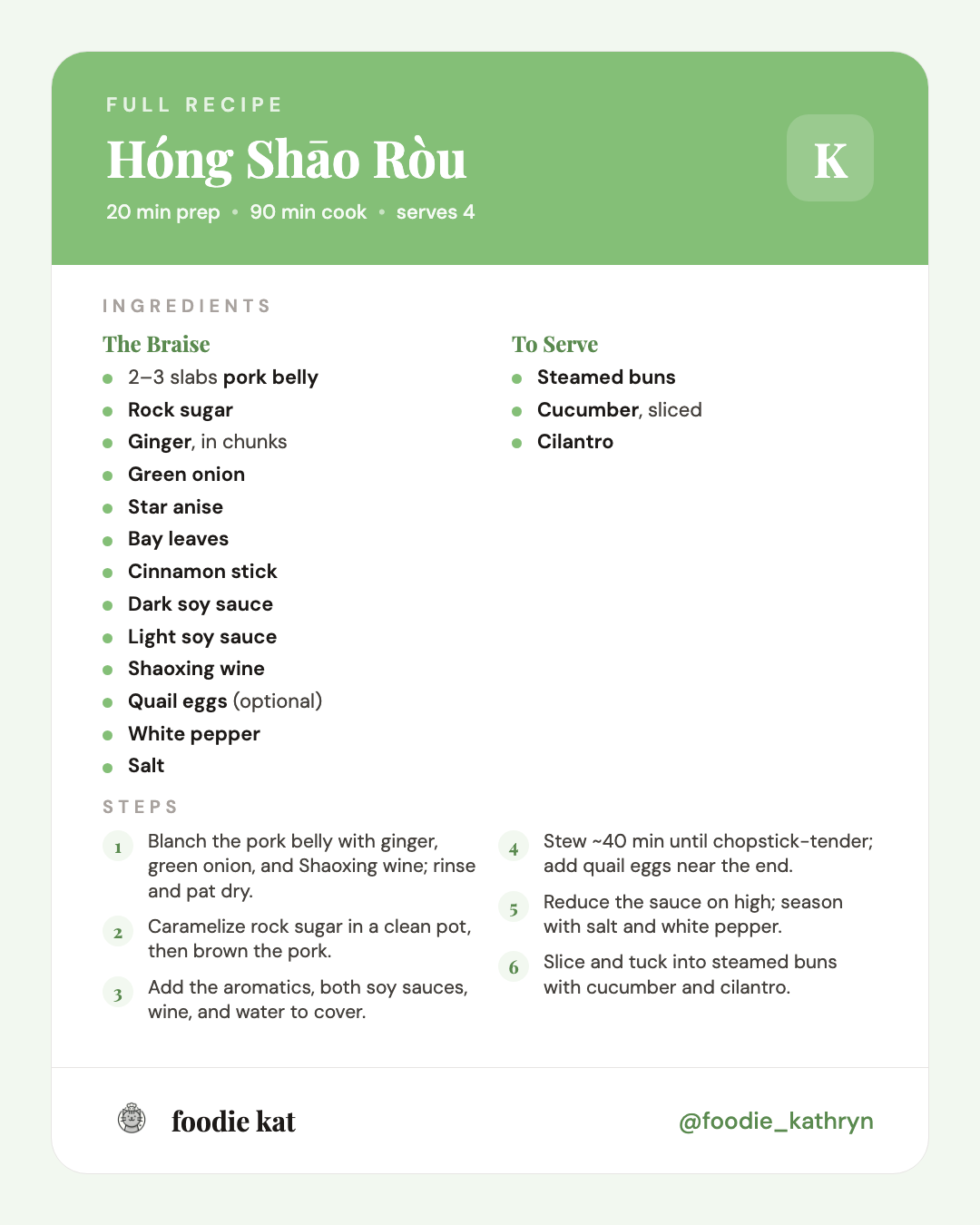
Ingredients
- 2–3 slabs of pork belly
- a couple of knots of green onion
- ginger, sliced into large chunks
- a handful of star anise
- a couple of bay leaves
- a couple pieces of rock sugar, for caramelizing
- one cinnamon stick
- a generous amount of dark soy sauce
- a splash of light soy sauce
- a splash of Shaoxing wine (for blanching and cooking)
- quail eggs, hard-boiled and peeled
- a good shake of white pepper powder
- salt, to taste
Instructions
- 1.Blanch the pork belly in boiling water with ginger, green onion, and a generous splash of Shaoxing wine. This draws out impurities and removes any gaminess.
- 2.Remove the pork belly from the pot, rinse under cold water, and pat dry. Discard the blanching water.
- 3.In a clean pot, add rock sugar and the blanched pork belly. Fry over medium-high heat, stirring occasionally, until the meat begins to brown and caramelize.
- 4.Add ginger, star anise, bay leaves, the cinnamon stick, dark soy sauce, light soy sauce, and Shaoxing wine. Pour in just enough water so the meat has plenty of liquid to stew in.
- 5.Reduce the heat and stew for about 40 minutes. Test doneness by poking the meat with chopsticks — if they slide through the thinner parts easily, it's nearly ready.
- 6.Add the quail eggs when the meat is almost done and let them cook through.
- 7.Before serving, crank up the heat to reduce the sauce. Taste and add salt if needed, then finish with a good shake of white pepper.
Notes
The quail eggs are optional but wonderful — they soak up the braising sauce and become these little jammy, savory bites. If you're skipping them, everything else stays the same.


How to Eat
Ingredients
- steam buns from 99 Ranch, steamed per package instructions
- sliced Hóng Shāo Ròu from above
- freshly sliced cucumber
- chopped cilantro leaves
Instructions
- 1.Steam the buns until pillowy and soft.
- 2.Slice the pork belly just before serving.
- 3.Tuck the sliced pork belly into a steamed bun with cucumber slices and cilantro.
- 4.Drizzle with extra braising sauce. You're in for a treat.
Notes
I kept the pork belly in larger pieces during the braise and sliced right before serving — it holds together better that way and you get a cleaner cut through the layers.


Summary
Honest Verdict
“After making this dish and hearing my husband and friends rave about it, I realized I had waited far too long to celebrate this classic. Better late than never. Good job to me!”
More from the kitchen

Dill Dumplings: A Letter to Grandpa
An unexpected encounter with wild dill during a hike resulted in a delicious meal and a fond memory of my grandpa's delightful dill dumplings.

Chóng Qìng Xiǎo Miàn (Chong Qing Small Noodle)
I was craving this addictive noodle dish but didn't want to pay so much just to feel uncomfortable, so I took matters into my own hands.

Taiwanese Cold Noodles
A nostalgic bowl of sesame-peanut cold noodles, chasing the street-vendor version that won our hearts on our first day in Taiwan — made to celebrate a very good fitness day.